5 min read
Why Children Love Seeing Themselves in Stories
The moment a child recognizes themselves in a book, reading changes. What personalized stories do for early literacy, engagement, and the bedtime routine.
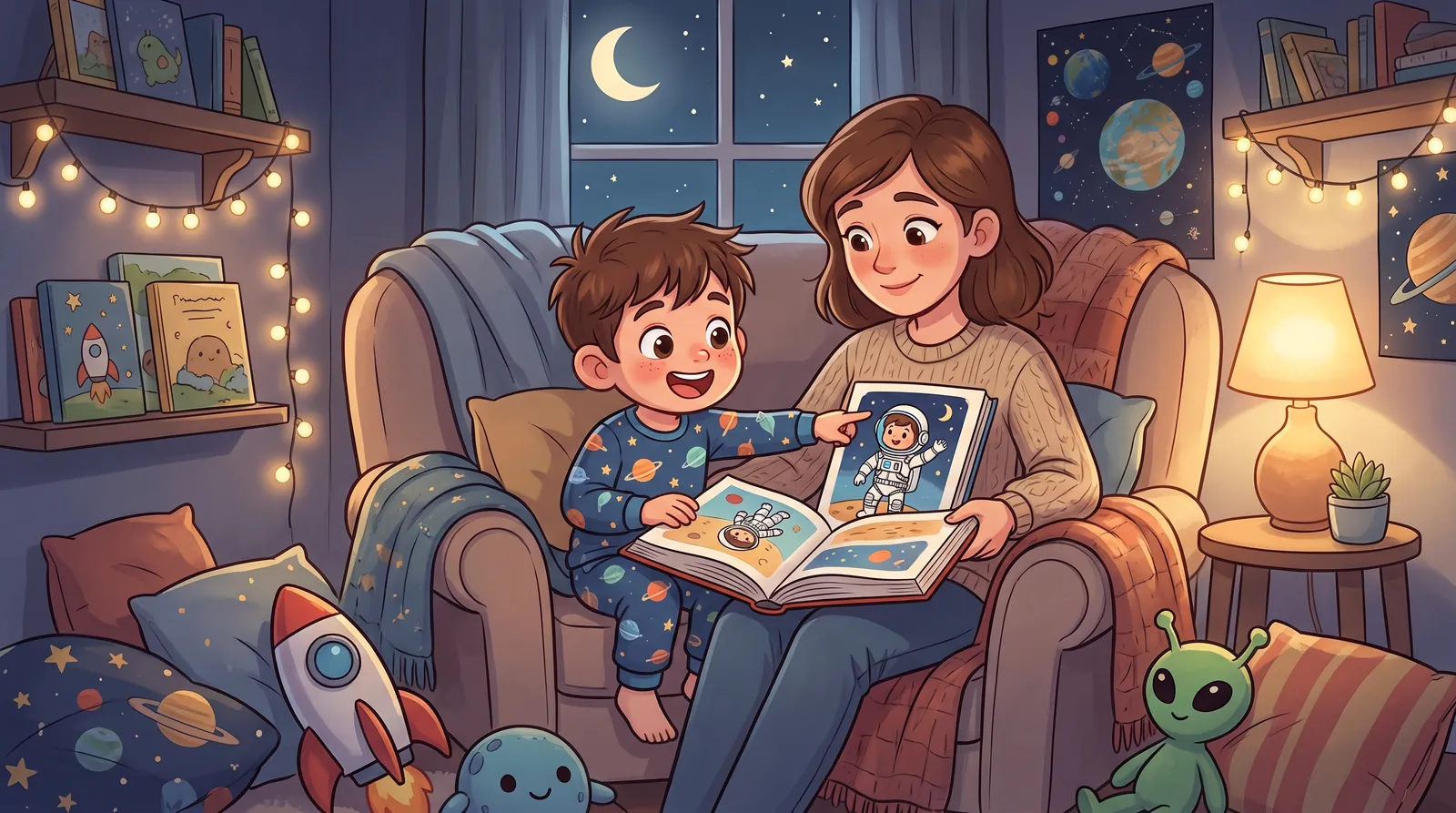
There's a moment every parent of a small child knows: you're reading aloud, your child is drifting, and then something on the page catches them — a dog like theirs, a red coat like theirs, a name that sounds like theirs. Suddenly they're sitting up, pointing, saying "that's me!" The story stops being background noise and becomes theirs.
Personalized books are built entirely around that moment. Instead of hoping a detail lands, the whole book does: the hero has your child's face, your child's name, and the story is addressed to them from the first page. Here's why that matters more than it might seem.
Books as mirrors (and windows)
Teachers and librarians often describe children's books as mirrors and windows. Windows let a child look out into lives and places unlike their own — essential for empathy and curiosity. Mirrors let a child see themselves reflected in a story — essential for feeling that books are for them, about them, and worth coming back to.
Most bookshelves are heavy on windows. A personalized book is the purest possible mirror: the child isn't just represented by a character who vaguely resembles them — they are the character. For a two-year-old who is still figuring out that the pictures in books relate to the real world, or a five-year-old nervous about the first day of school, seeing themselves inside the story collapses the distance between the page and their own life.
To be clear, mirrors don't replace windows. Children need a varied shelf full of other lives, other places, and other kinds of heroes. But the mirror book tends to become the most-requested one on the shelf — and a most-requested book is exactly what early readers need.
Engagement is the engine of early literacy
Before children can read, they learn what reading is for: that pages turn in order, that squiggles carry meaning, that stories have shapes. All of that is absorbed through repetition — the same books, read again and again, often to the point of memorization. Ask any parent who can recite a bedtime book from memory.
Repetition only happens when a child wants the book again. That's why engagement isn't a nice-to-have in early literacy; it's the engine. A book a child begs for gets read fifty times, and fifty readings teach more than five readings of ten worthier books. Personalization is one of the most reliable ways we know to make a child beg for a book, because the pull of "a story about me" doesn't wear off the way novelty does.
A child's own name is a doorway into print
For most children, their own name is the first word they learn to recognize in print. It's the word on their cubby, their drawings, their birthday cake. Long before they can sound out anything else, they can spot those particular letters across a room.
A personalized book puts that one word they own inside a real story, on page after page. Every time it appears, there's a small jolt of recognition — and a natural chance to point at it, trace it, and connect the letters to the sound of it being read aloud. It's a tiny thing, but early reading is built out of exactly these tiny things: moments where print stops being decoration and starts carrying meaning.
The bedtime routine gets easier
Bedtime reading works best when it's a ritual: same time, same lap, a book the child chose. The hard part is usually the choosing — and the negotiating that follows.
Parents tell us the personalized book short-circuits a lot of that. It becomes the default request, the safe landing after a chaotic day, the one where a wound-up child settles because the story is literally about them being brave, or kind, or going to sleep. A story in which your own child says goodnight to the moon carries a bit more weight at 7:30pm than one about a generic bunny.
There's also something quietly powerful about the message underneath: someone made a book about you. Children read that as being loved — which, of course, is exactly what it means.
What this looks like in practice
At StoryMagic, we build each book from a fully illustrated 24-page story, then blend your child's face into the hero on every character page and weave their name through the text. You upload one photo, pick a story matched to their age, and see a free preview — your child as the hero on the cover and sample pages — before deciding to buy, as a printed hardcover or softcover, or an instant digital copy.
But whether or not you make one with us, the underlying idea is worth stealing: children lean into stories where they belong. Put your child at the center of a story — a homemade one, a made-up one at lights-out, or a printed one — and watch what happens to their appetite for books.